Much has been written about the widening skills gap, the erosion of traditional craftsmanship, and the struggle to attract new entrants into the traditional, wooden boatbuilding industry. Yet the topic has taken on new urgency following a series of high-profile setbacks for the sector.
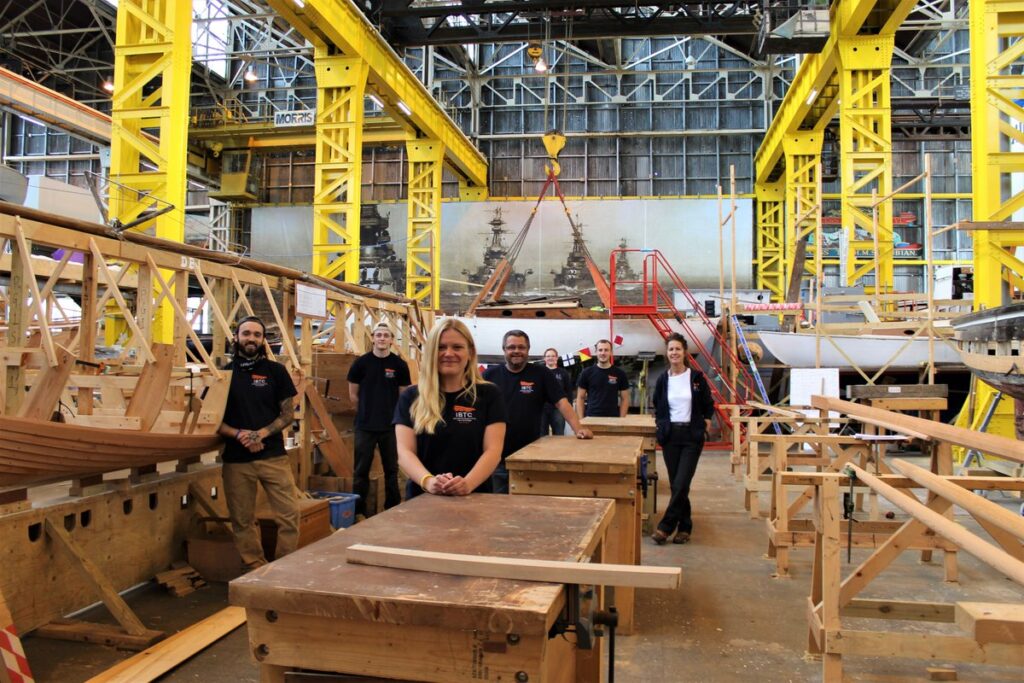
The slow decline of traditional wooden boatbuilding reached a critical point at the end of 2024 with the closure of the International Boatbuilding Training College (IBTC) in Lowestoft, Suffolk. Established in 1975, the college trained generations of boatbuilders, conservators, and carpenters. But a combination of challenges – including Brexit, the covid pandemic, the war in Ukraine, escalating material and energy costs, and dwindling student numbers – ultimately proved insurmountable.
“The closure of the International Boatbuilding Training College (IBTC) Lowestoft was more than a local tragedy; it was a signal flare,” says Tom Marfleet of Emsworth Harbour.
The loss of its courses not only impacted would-be boatbuilders, but also deckhands, riggers and yard workers who gained broader practical skills there. In 2023, traditional wooden boatbuilding was added to the ‘Red List of Endangered Crafts’ compiled by the Heritage Crafts Association. Traditional wooden boatbuilding was placed alongside other marine-related trades now classed as endangered – from barge painting and rope making to sail, spar, and oar production. A key factor cited was the lack of formal training opportunities and that was even before the IBTC closed its doors in Lowestoft.
The International Boatbuilding Training College (IBTC) in Portsmouth is to close in March 2023. IBTC Portsmouth teaches traditional wooden boatbuilding…
Today, only a handful of training centres remain – notably the Boat Building Academy in Lyme Regis is a key establishment. Its work has become all the more vital as the industry contemplates how to preserve — and revive — the art of traditional boatbuilding.
Boat Building Academy in Lyme Regis
The Boat Building Academy (BBA) in Lyme Regis, UK, has evolved significantly since it was founded in 1997, both in size – having added more workshop space during covid and also in the breadth and diversity of its courses.
As well as developing a thriving furniture making school, the academy now offers a comprehensive practical study programme ranging from tasters and short courses to the 12-week furniture making course and the industry renowned 40-week boatbuilding course.
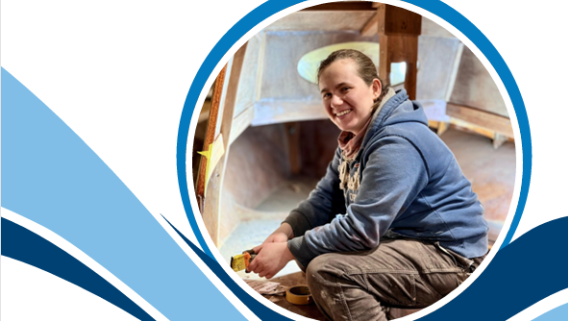
Attaining charitable status has enabled the BBA to offer a rapidly growing bursary programme, and in recent years its collaboration with Women in Boatbuilding (WIBB) has greatly increased its numbers of women students.
Alongside much needed diversity and accessibility across the marine sector, the shortage of skilled tradespeople has long been a concern for the industry.
With traditional crafts, in particular, the BBA is one of a dwindling number of institutes where students can learn age-old crafts, alongside new techniques.
Will Reed, the director and co-chair of trustees at the Boatbuilding Academy, says the school is addressing the skills gaps by “focusing on our key skills – training in modern and traditional wooden boat building. Also, by investing in new machinery, talking with industry, and doing all we can to maintain the highest quality, relevant training.
“We’ve also made great strides in making our courses more accessible through bursaries. Young people often have less money, and a bursary can determine whether they can take our course or not.
“We’ve invested in PR to shout about what we do and we are working with organisations including Women in Boatbuilding to show women and young people that the marine sector isn’t closed off and exclusive but is open to them.
“Developing strong relationships with employers also ensures we’re doing the right thing and can feed the yards with great people at the beginning of their career, or after they’ve built up further experience.”
The academy has aimed to encourage students from all walks of life to consider boatbuilding and learn the crafts.
“Men and women of all ages come to the BBA. School leavers and career changers looking to forge a new path, career developers who are enhancing their skills – perhaps carpentry or boat related work. Some come in retirement doing it for the sheer joy.”
“Our new 40-week cohort includes young people who have chosen the course over going to university, a former banker, a former teacher, joiners and carpenters looking for their next challenge, keen sailors, people who have never sailed and a retired Formula One car designer.”
Reed is a former student of the BBA. “I was in the career development camp when I did the course in 2006,” he explains.
“Having studied a furniture making and design degree and working in the furniture making industry for five years, I wanted to expand my skills into the incredible world of compound curves and beautiful objects that can actually sail and move under the power of the wind.
“But many of our students are complete beginners who throw themselves into it and begin exciting and rewarding careers.”
Meeting industry needs: government backing needed
Reeds highlights that as the marine industry evolves, so must the skills of the BBA’s cohort.
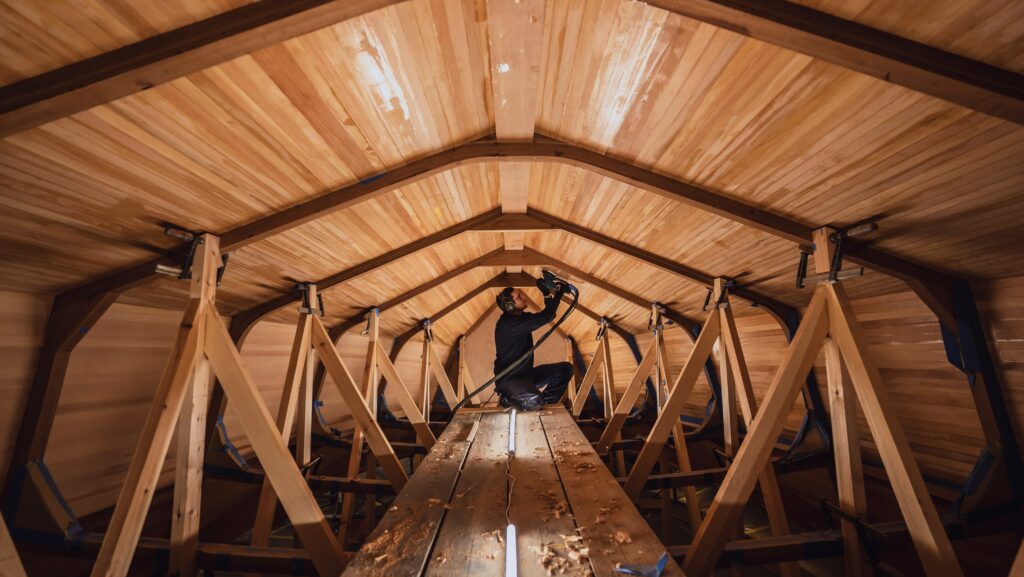
The BBA is incorporating new tech to its disciplines, where applicable.
“We are constantly looking for more sustainable timber and materials and work closely with organisations such as Sykes Timber. We also explore partially plant-based epoxy resins and install electric motors when appropriate. It’s an exciting time for the industry as it steps up to the need to be more sustainable and we want our students to be a forefront of those discussions when they enter yards,” Reed adds.
He says the academy communicates with the industry to “make sure we’re hitting the right buttons”.
“As the only remaining wooden boatbuilding school in the UK, we take our responsibility to supply employers with the skilled craftspeople they require very seriously, and so always welcome input and feedback.”
Spirit Yachts P50 build. Image courtesy of Luke Dorey
“We are working with Spirit Yachts to better understand their requirements, and Jack Livesey of Paradise Boats on efficient practices.
“Tutor Justin Adkin rejoined our expert team this year and comes with a wealth of knowledge from many years’ experience with traditional and modern boats – from Nautor Swan, to running his own business building anything from Salcombe Yawls to ocean rowing boats.”
Reed echoes the sentiments of many others in the segment when calling for more support from the government and education sector.
“I’m lucky that my son’s school in Lyme Regis offers excellent DT facilities and dedicated tutors but this is not the norm,” Reed says.
“Many schools are sadly lacking in this area. Many children are not academic and would thrive if they were given further opportunities to engage in practical work. To support this, we offer fully subsidised taster days for school children and longer opportunities for those who struggle with the traditional schooling system.”
Women in boatbuilding
The BBA has well established relationships with marine organisations and boatbuilders that are helping amplify its platform and spread the word.
“Our collaboration with Women In Boat Building (WIBB) and its founder Belinda Joslin has been incredibly important to the BBA and the industry it supports,” says Reed.
“Many more women are now interested and see a place for themselves in the industry and a way forward in boatbuilding because of this work.
“Through bursaries for women, an inclusive environment, promotion of opportunities and close links with industry, we are making big differences with a significant shift in numbers over the past year.”
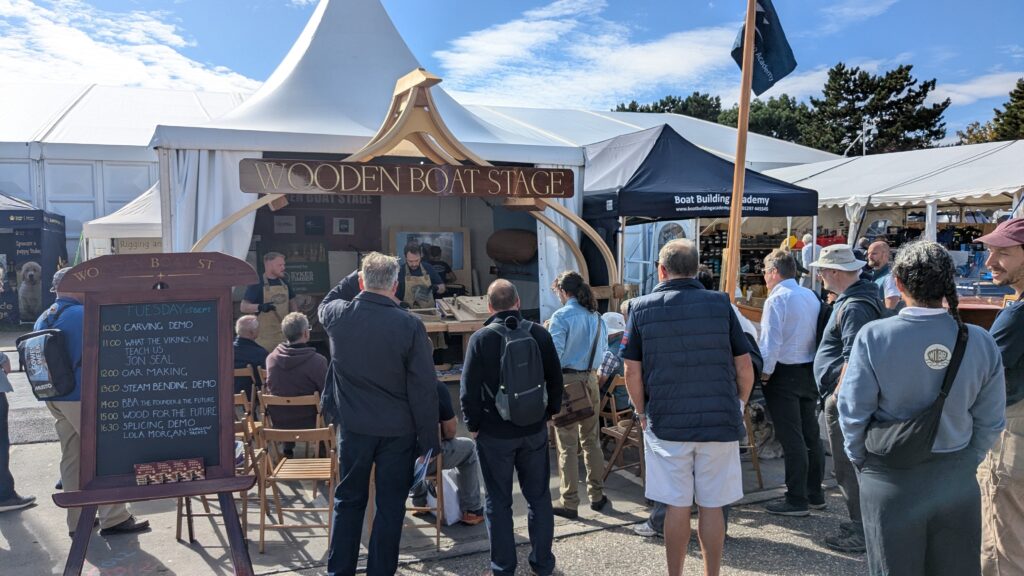
“As three organisations at the forefront of keeping traditional skills relevant, accessible, and inspiring the next generation, we teamed up to create the Wooden Boat Stage. We had live demonstrations of everything from carving, steam bending, and oar and paddle making, to epoxy work, knotting, and rigging, alongside a programme of panel discussions, author talks, short films, and workshops.
“Our aim was to showcase both traditional craftsmanship and modern techniques and we received tremendous feedback from the industry. We have also collaborated with the boatbuilder Dan Lee and Wessex Resins.”
At a time when timber and materials costs are on the rise, and thus potentially deterring people from buying or maintaining wooden boats, Reeds says initiatives like the Wooden Boat Stage at SIBS are much needed.
“We hope to encourage more people to feel excited about investing in wooden boats for the benefit of their boating experience, as well the huge benefit to the industry.”
Cross collaboration
Getting well trained people into the right jobs remains the biggest challenge facing the UK’s boatbuilding and repair sector today. And Reed says there are ample opportunities for closer partnerships between training institutions and industry.
Closer cross collaboration could emerge in the form of shared apprenticeships and R&D projects.
“We are currently exploring some exciting options for paid internships following the 40-week boat building course.
“Funding for bursaries for our training is also an ongoing challenge. But we are developing an impressive database of boatyards we work with to get the right people into the right jobs.”
“Rather than yards seeing each other as competitors, there is a power in collaboration – to raise the profile of what we do, both nationally and globally. The UK’s wooden boat scene is behind when we look at France, Australia, US – there is a lot more we can do to work together as a UK industry – it’s an exciting time.”
Leave a Reply