
Marine Futures founder Ollie Taylor acknowledges why the industry is experiencing sustainability fatigue.
“I think businesses are so preoccupied with just trying to simply survive crisis after crisis,” Taylor explains.
“First covid, then Ukraine, now Iran – it’s an incredibly challenging time to be a boatbuilder, and they don’t want to add extra complexity.
So for us, it’s about showing how sustainability can also build resilience into a business.
“MarineShift360 [a purpose-built life cycle assessment tool for the marine industry, founded by 11th Hour Racing and delivered by Marine Futures] is about giving real world examples that show sustainability doesn’t necessarily cost businesses loads of money or add challenges.”
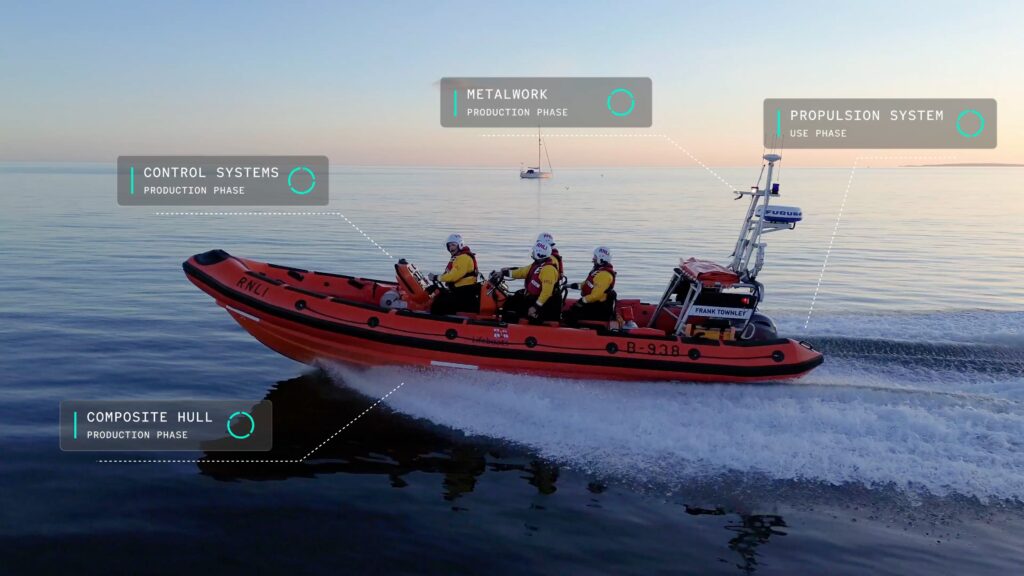
Evidence-based data to battle sustainability apathy
After winning a DAME Design category award in 2022, the MarineShift360 tool has gained traction with industry leaders such as North Sails, SailGP, IMOCA, Williams Jet Tenders and Starboard.
In April 2026, three companies were selected for the 2026 MarineShift360 Impact Accelerator programme: Gurit, a composite materials and engineering company; MobyFly, a Swiss-Portuguese technology firm building zero-emission hydrofoil passenger vessels; and nlcomp, a composite materials supplier developing fully recyclable thermoplastic systems.
The year-long initiative equips the marine businesses with life cycle assessment expertise, technical consultancy and access to an industry-wide sustainability network.
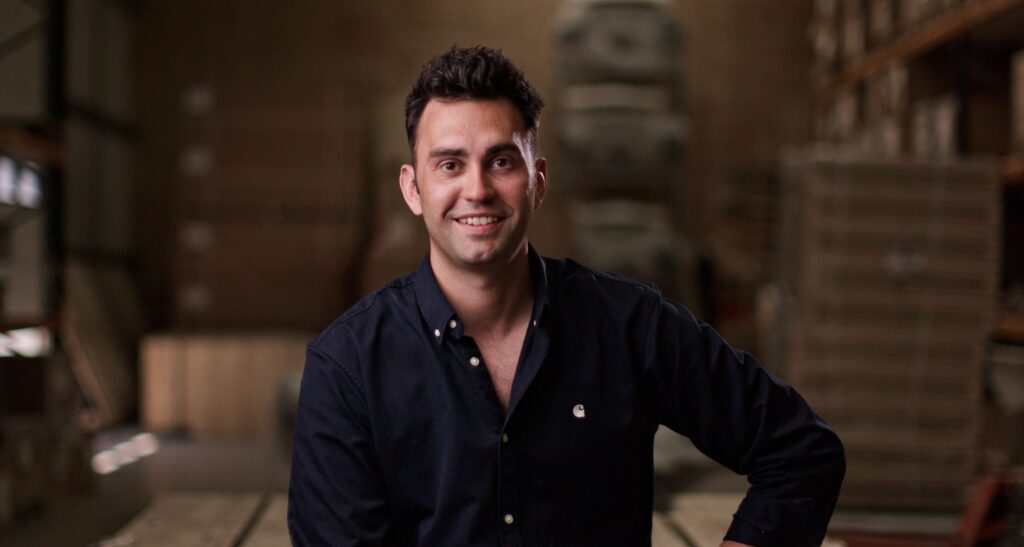
“People are bored of hearing about the next sustainable solution. They want to see it in action and the proof. So we’re trying to create those examples in the industry via the programme,” explains Taylor (pictured).
What can be done about greenwashing?
The 2026 cohort agree that third-party validation and hard data are essential to prove to clients that sustainability translates into bottom-line savings.
Sue Putallaz, co-founder and CEO of MobyFly, says that validation from the Accelerator programme will counter widespread – and frustrating – industry greenwashing.
“Being selected by MarineShift360 gives us the framework to strengthen our approach through the life cycle assessment of our vessels,” she says. “Crucially, though, it also allows us to prove our sustainability credentials via an independent party.
“It’s easy for [everyone] to claim something, it’s about proving it. In this field there is a lot of greenwashing, so that’s what makes the real difference for us.”
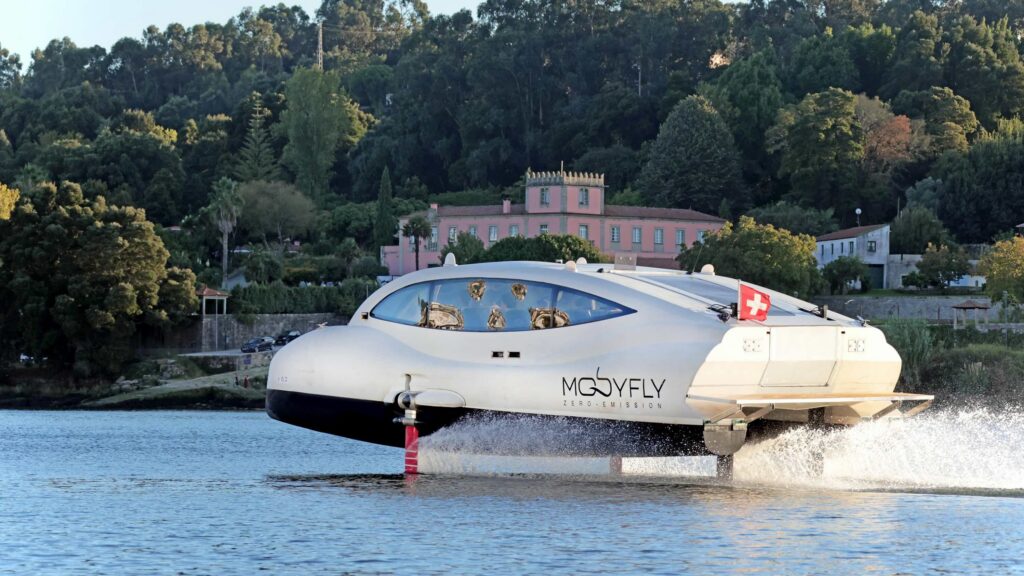
Putallaz hopes this kind of neutral data verification will also help convince the industry to push forward and see sustainability as “bankability”.
Highlighting the need for verified metrics, Taylor notes: “There’s so much greenwashing in the industry with press releases claiming this and that – but often no data that sits behind them to prove whether it’s good, bad or the same.
“The MarineShift360 tool gives you the actual quantified data to tell you, ‘yeah, you’re doing the right thing’ or ‘no, actually, your hypothesis was completely wrong and you’ve made something much worse environmentally’.”
Taylor argues that by adjusting their approach to internal eco assessments, marine businesses can make better strategic decisions.
“During a recent panel with material manufacturers, the host asked what initial step boatbuilders should take. The suppliers naturally advised adopting their own resins or recycled carbon fibre and so on,” Taylor recalls.
“But my answer is, you don’t know what you should do until you know the impact of what you’re producing already. Where does that impact occur? Is it in your production processes and materials? Is it in the life use? Unless you know that, you’re kind of shooting in the dark with what you introduce to the system.”
According to Gurit, demand for actionable life cycle analysis is increasingly driven by commercial pressures. Nicolas Siohan, principal engineer for Gurit, reports strong interest from high-performance motor yacht, sailing superyacht design and refit sectors.
In this arena, Siohan says “advanced composites are critical to achieving weight reduction, structural efficiency and premium finish, as well as in the fast-growing segment of unmanned marine vehicles, where lightweight and durable core materials directly support range and operational reliability.”
Building supply chain immunity
With recent global conflicts disrupting energy and raw material pipelines, Taylor believes manufacturers
need to re-evaluate their key vulnerabilities.
“Sustainability is an overused word with lots of fatigue at the minute. But ultimately, it’s the right move because it gives [manufacturers] resilience against supply chains that they can’t control.”
Adopting commercial strategies that factor in sustainability is a business-critical decision which makes the most sense, according to Taylor.
“If you want to build a business that’s successful in the next five, ten, 15 years, you can’t keep running it the way you ran it the previous ten years,”
Taylor continues: “Material availability and resource economics are fundamentally changing.
“I can’t tell you over what time horizon resource scarcity is going to really bite. But what I can tell you is that in the last six years, all we’ve seen is massive increases in materials costs, input costs into business and supply chain volatility, etc.
“So why wouldn’t you try and create a business model that decouples you from a supply chain that controls your margin? It’s a commercial decision, and a business-critical one, long before it’s an environmental one. Controlling your own inputs is supply security.
“Build a boat you can take apart and reuse, and the next spike in material prices stops being your problem.”
This article was originally published in Marine Industry News magazine. Read more issues here.
The post From greenwash to hard data: the commercial case for lifecycle assessment appeared first on Marine Industry News.