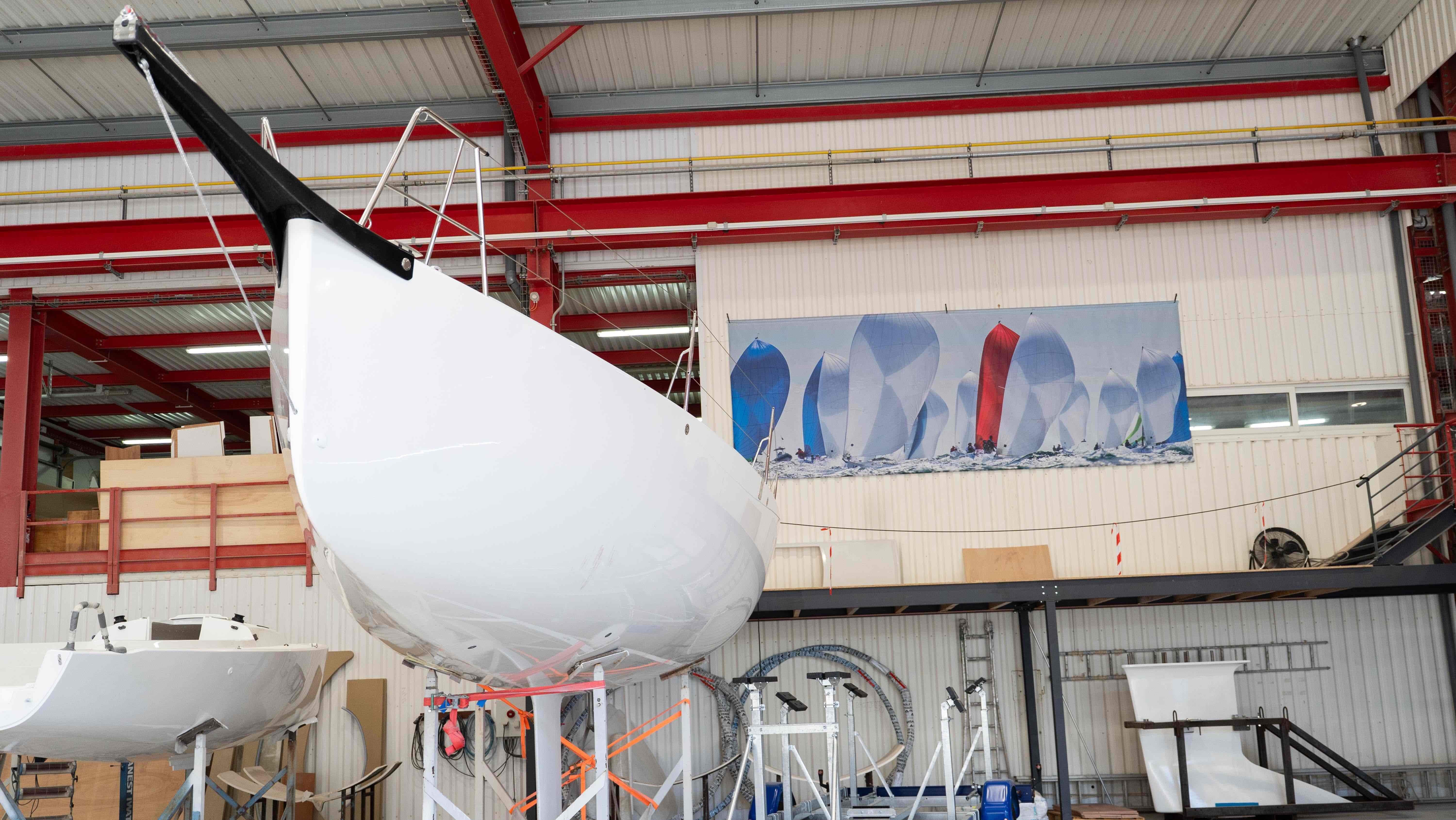
Orders are there, but the people needed to build the boats are harder to find. At J Composites in Les Sables d’Olonne, France, CEO Didier Le Moal is navigating a familiar manufacturing challenge while holding firm on a less conventional principle: the customer doesn’t always get the final say on the boat’s specification.
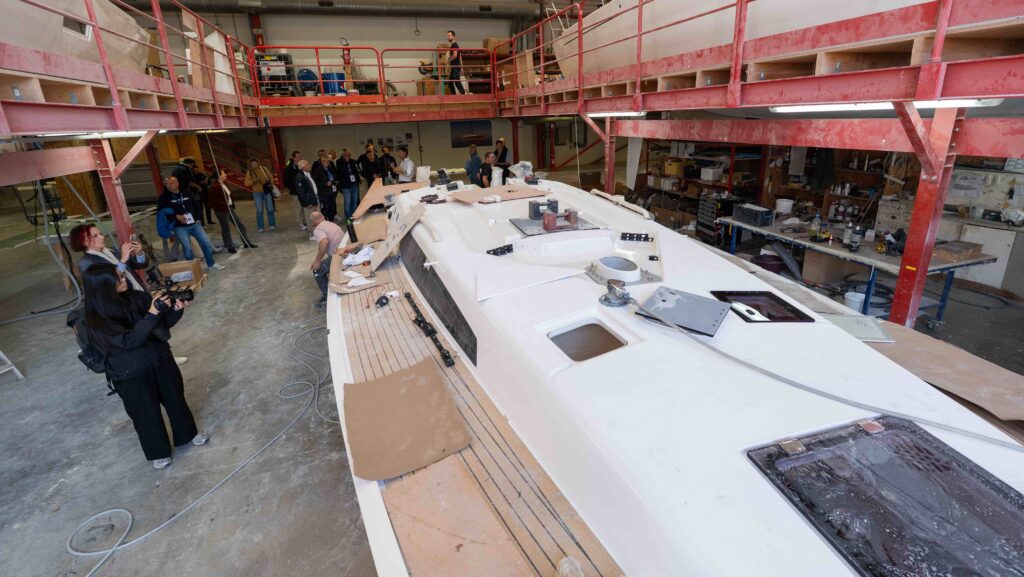
“We are world champions of making things complicated,” says Le Moal, also the firm’s president, speaking of France’s business climate while showing MIN around the yard as it readies itself to exhibit at least three boats at January’s boot Düsseldorf.
According to Le Moal, J Composites’ production has been constrained in the past two years by a shortage of workers, rather than by lack of orders. The company currently employs 60 people and continues trying to recruit more. That’s complicated by the site’s location, which limits the geographic labour pool, as well as by broader challenges in France.
It’s not a “crisis”, Le Moal says, but it is “complicated.”
He estimates the yard makes about 200 boats a year, roughly split between small boats and those with cabins onboard, and orders continue to rise.
How J Composites developed its sailing yacht range
Le Moal founded J Composites in 1994. Initially established to build J/Boats designs under licence for the European market, the company assembled its first J/92 in 1994, followed by models including the J/80 and J/120, with interiors adapted to European customers. In 2001, it launched the J/109, the first model developed jointly by the French team and J/Boats. Construction methods include composite sandwich structures and resin infusion.
Its sailing yachts span three ranges: performance cruisers (inc. J/36 cruising comfort, J/40 offshore capability and J/45 offshore performance), sport sailboats (inc. J/70 one-design racing yacht and J/99 high-performance racing) and daysailers (J/7 offers spacious cockpit, manageable sail plan and emphasis on ease of use).
Owned and managed by sailors, Le Moal says the team’s weekend sailing experience can be brought back into product improvement and changes at the start of the following week.
Why J Composites limits customisation
One aspect that isn’t changing is J Composites’ approach to customisation.
There is a limited number of options compared to other builders. “There is a two- or three-cabin version,” explains Le Moal. “There is a two wood colour choice. There is an optional cupboard.”
This is an unapologetic stance in an industry where customisation crops up in every other sentence.
“It’s not our job. We do performance sailing boats. These boats are expensive to build because of the attention we pay to the rigging,” and other items.
The yard designs “true” sailing boats with a primary objective of “good sailing ability”. Then it fits in what it can afterwards. This means Le Moal’s willing to specify large winches, a large keel and an appropriate ballast ratio when needed, rather than economising on these elements.
“It’s rather impossible to imagine that we [will] accept to do different things on the request of the client.”
On the company’s J/45, the keel weighs 4.35 tonnes – around 43 per cent of the boat’s 10-tonne displacement. He describes the keel as a significant consideration in the boat’s design and cost and notes it is the most expensive item in the boat’s bill of materials, with a price tag higher than a carbon mast. Upper sections are made of iron, lower sections of lead.
From the UK to the US: J Composites’ changing markets
The client base has developed in recent years, with the UK market shrinking since Brexit. Currently he says the US is the yard’s largest market and there’s growth in France, Australia, Germany, the Netherlands, Italy and Spain.
But J Composites ships boats wherever there is a sailing culture. As an illustration of its international presence, Le Moal says 23 nations (on over 100 boats) raced on the same course in September’s J/70 World event in Cascais, Portugal.
Now the company’s currently working on three J/99s for a sailing club in Australia; the Spanish Navy fairly recently bought eight. The J/70 is popular. A client in Saudi Arabia recently bought ten for match racing. Le Moal believes there are now close to 2,000 J/70 boats on the water.
Popularity and continued success come because the yard prioritises lightweight, high-performance, structurally integrated sailing boats rather than maximum volume or – as mentioned above – extensive bespoke customisation.
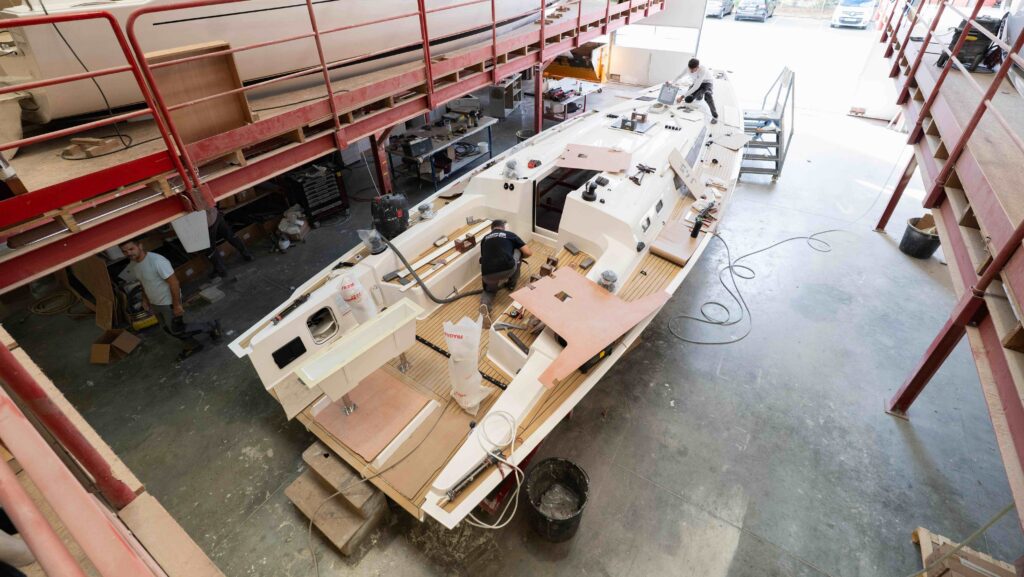
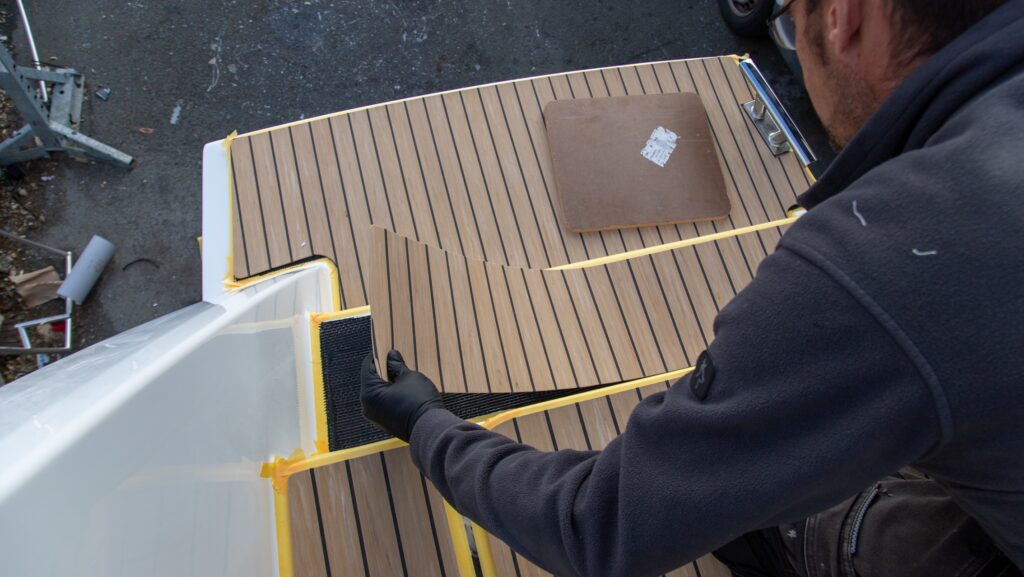
It also embraces change. For example, the yard began working with Flexiteek several years ago.
“At some stage we were offering Flexiteek and true teak and finally we decided to stop the wood. And, no one came to say: ‘Oh, no, I want the true wood’.”
Le Moal notes that Flexiteek’s product has “made a lot of progress and looks like true teak.”
For Le Moal, it all ultimately comes back to what happens when a boat leaves the yard. J Composites can change its materials, refine its construction methods and pursue new markets, but its underlying priorities remain the same: build a boat that sails well, and resist changes that compromise that objective. In a market where personalisation is often part of the pitch, that is a position the company has no intention of abandoning.
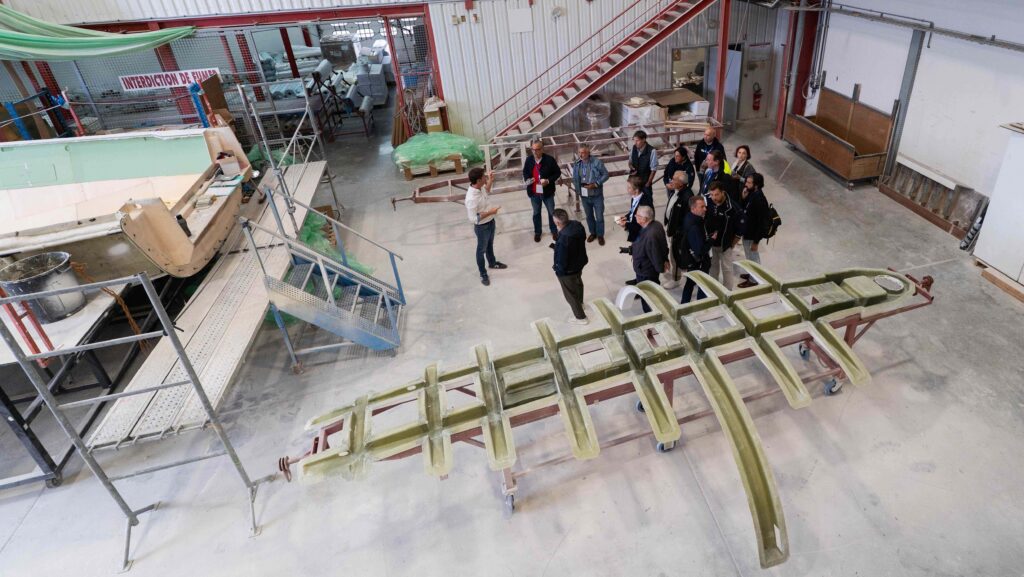
Inside the factory: how J Composites builds its boats
Why vacuum infusion matters to sailing performance
Hulls, decks, structural components, bulkheads, rudders and many smaller laminate parts are made using vacuum infusion: dry fibres and core material are laid into the mould, vacuum-bagged and then infused with resin. The purpose is not primarily production speed or reduced styrene emissions, but improved fibre-to-resin ratio, lower weight, strength, consistency and sailing performance. Careful fitting of dry materials is necessary to avoid resin-rich gaps that would add unnecessary weight.
Building hull integrity into the structure
The complete outer skin uses vinylester resin to support osmosis resistance. Through-hulls and seacocks are moulded into the hull rather than drilled afterwards, with the aim of providing a watertight transition and reducing routes for moisture ingress. Structural grids and bulkheads are infused separately and then glued and laminated into the hull in contrast to some yards that install a complete inner liner or moulded arrangement. J Composites uses internal arrangements as structural elements to reduce weight and maintain hull stiffness.
Manufacturing, tooling and assembly in-house
The yard produces most laminate components in-house, including rudders, while generally purchasing larger moulds from specialist subcontractors; smaller-part moulds may be made internally. Injection moulding with matched moulds (closed-mould resin injection) is used only for small components such as hatches, sail lockers and covers where both visible faces need a finished appearance. The yard avoids using this method for large decks because the required mould gap adds resin and weight, reducing mechanical performance.
The post J Composites prioritises sailing performance as demand outstrips capacity appeared first on Marine Industry News.