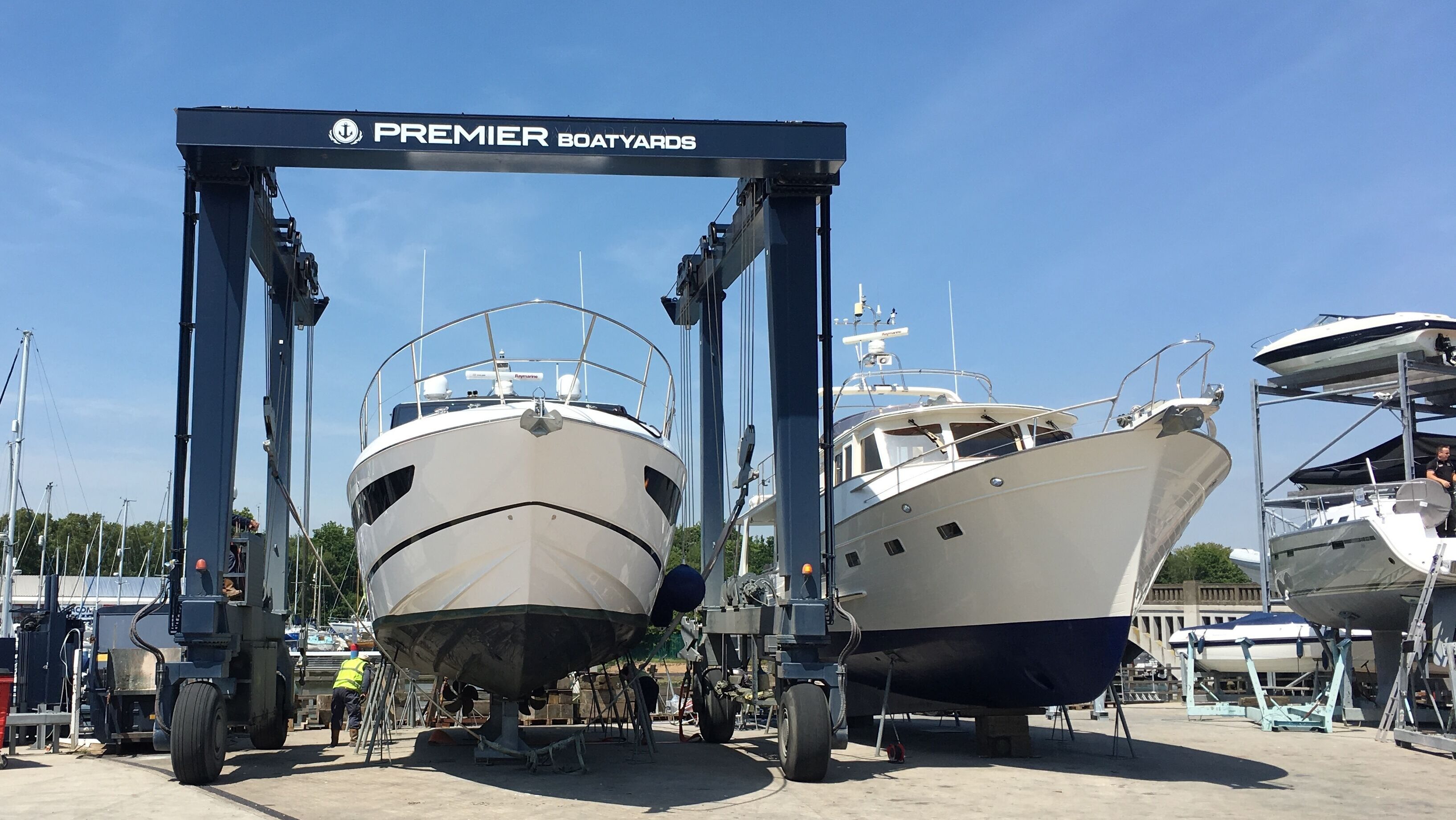
Premier Marinas has stopped lifting, launching and accepting boats with silicone antifouling for storage ashore across its boatyards, following an incident in which a vessel secured ashore ‘gradually shifted’ (the marina chain hasn’t specified which coating was used on the vessel).
“An incident at one of our boatyards this summer prompted us to reassess how we handle vessels with silicone-based antifouling,” a Premier Marina spokesperson tells MIN. “In September, we took a group-wide decision to stop accepting vessels with these coatings for lifting, launching or storage ashore. Applying that decision across all our yards gives our teams a clear operating policy while the review is under way.
“As a boatyard operator, we have a responsibility to protect our teams and customers and to minimise the risk of damage to the boats entrusted to us. That responsibility extends beyond the lift itself – we need to be confident that a boat can be lifted and launched safely and that it will remain securely supported for the whole time it is ashore.”
The decision raises questions about whether the problem is with silicone coatings, the way vessels are supported ashore, or a combination of the two.
Silicone-based foul-release coatings are designed to create a very smooth, low-friction surface that makes it difficult for marine organisms to attach to a hull. Unlike conventional biocidal antifouling, they work by reducing adhesion rather than releasing substances to kill marine growth.
Biocide-free coatings can offer environmental benefits
MIN has previously covered the development and environmental benefits of biocide-free coatings – specifically Hempel’s Silic One.
In 2024, Hempel also introduced Infinity to apply on top of its Silic One system as a recharger, with no sanding, no painting, and no masking off at the water line needed. At the time Thomas Olsen Hempel’s marketing director, yacht, told MIN: “A lot of the products that usually come out of the coatings industry are small scale advances that move us forward, but we have something here now which is radically looking at it from the boat owner’s perspective, making their lives easier. We want people out sailing. We don’t want them standing around fixing boats.”
MIN asked Hempel if its has been contacted directly by either marina chains, or individual boat owners, looking for clarity around the products – at time of publication MIN has received no response.

A wider boatyard issue for lifting
The practical challenges are not confined to Premier Marinas. Some marina operators have formal policies covering silicone and other low-friction coatings, but the industry response is not uniform.
Yacht Havens’ August 2026 terms and conditions identify silicone and Teflon antifouling as treatments that can make lifting, moving and blocking vessels more hazardous. Customers are required to disclose these coatings, and vessels unsuitable for conventional shores or stands may need an appropriate cradle.
‘It is your responsibility to ensure that you have notified us of any vulnerable features on the hull and any features or treatments that make the lifting, movement and blocking of the vessel more hazardous, (including but not limited to) the application of Teflon or Silicone antifoul products, lifting keels or keels that are not designed to be weight bearing,’ says the literature.
Its dry-stack operations at Haven Quay Lymington and Yacht Haven Quay Plymouth charge a 50 per cent surcharge on lifting charges for vessels with silicone or Teflon antifouling. MIN approached the organisation for further comment, but was unable to connect with the appropriate person.
Beaulieu River’s 2026 boatyard application also asks customers to declare whether their boats have silicone or Teflon antifouling.
MIN also contacted MDL Marinas, but the company hadn’t responded by the time of publication.
Practical Boat Owner’s guide to biocide-free antifouling identifies lifting straps and boatyard stands as potential difficulties with slippery silicone hulls. It notes that chocking up these boats can be challenging and describes tying sling straps together as a sensible precaution.
Owner describes cancelled lift-out
One boat owner told Yachting Monthly that Premier had previously lifted and stored their yacht, which was coated with Hempel Silic One, without difficulty and says the yacht was lifted at a South Coast Premier boatyard in December 2023, when the coating was applied, and relaunched in January 2024. It was lifted again at Premier Chichester in July 2025 for a short maintenance stop.
But a recent booking for a lift-out and four weeks of ashore storage was cancelled after the owner was told that Premier was no longer accepting boats with silicone antifouling.
“Our team is working directly with manufacturers of antifouling coatings and boat storage equipment, bringing the practical experience of our yard teams into those discussions,” says Premier’s spokesperson. “Together, we’re examining whether changes to equipment or working practices would allow us to handle these vessels safely at every stage.”
What does Hempel recommend?
Hempel’s technical guidance acknowledges that silicone-coated hulls require particular care during lifting. Its Yacht Pro Underwater System Manual includes a section specifically covering lifting practices for silicone hull coatings.
The manual recommends using plastic sheathing on lifting straps to prevent excessive lateral pressure on the coating, protective blocks beneath the rub rail or chine, and spreader blocks above it. It also advises keeping straps as vertical as possible and connecting the fore and aft straps with a sling or suitably rated strap to prevent them separating during lifting.

Hempel describes these measures as advice intended to prevent damage to its silicone coating through incorrect lifting practices. The manual is explicit that responsibility for the safe lifting and movement of the yacht remains with the yard or customer. The guidance is available in Hempel’s Yacht Pro Underwater System Manual (manual pages 52-53, 2024). Hempel’s consumer-facing Silic One product guide also addresses the query (manual page 10, 2023/24). In a Q&A it asks about being afraid of too slippery surfaces when lifting the boat on slings and answers: ‘You should simply secure the lifting straps together and to each other to prevent them spreading apart when lifting.’
Premier looks to minimise risk of damage
The incident, as described by Premier, involved a vessel shifting while secured ashore. The company has not said that the boat fell from its cradle, nor has it identified the brand of antifouling on the boat at the time. Premier Marinas owns 22 sites around the UK.
“We recognise the disruption this causes owners planning maintenance,” concludes Premier’s spokesperson. “We would only resume these services once we’re satisfied our teams can consistently put the necessary measures into practice to protect people and minimise the risk of damage to vessels in our care.”
The post Silicone antifouling under scrutiny as Premier Marinas suspends some lifting and storage appeared first on Marine Industry News.