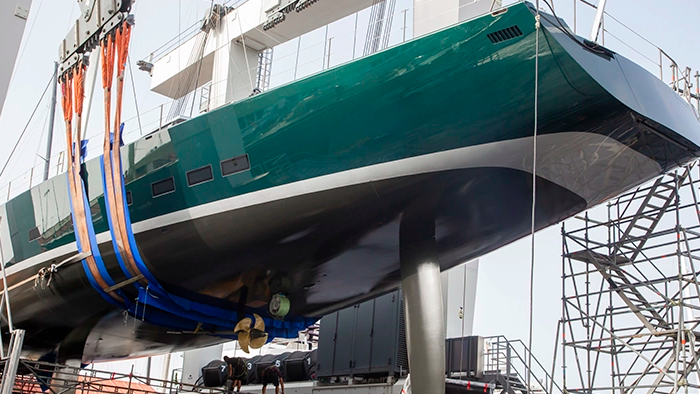
Following the cessation of lifting, launching and storage of boats with silicone-based antifouling by Premier Marinas (while it reviews procedures and works with manufacturers), Hempel – maker of industrial, protective, marine and decorative coatings – says it is working with the UK-based marina group to “better understand the situation.” It’s also recommending that owners inform their boatyard in advance if their vessel has a silicone-based fouling-release coating.
After an incident in September 2026 at a Premier Marinas boatyard prompted a reassessment of how vessels with silicone-based coatings are handled, the marina group decided to stop accepting boats with certain coatings for lifting, launching or storage ashore. The incident, as described by Premier to Yachting Monthly, involved a vessel that ‘gradually shifted’ while secured ashore. The company has not said that the boat fell from its cradle, nor has it identified the brand of antifouling on the boat at the time.
“As a boatyard operator, we have a responsibility to protect our teams and customers and to minimise the risk of damage to the boats entrusted to us. That responsibility extends beyond the lift itself – we need to be confident that a boat can be lifted and launched safely and that it will remain securely supported for the whole time it is ashore,” a Premier spokesperson told MIN.
Hempel recommends advance disclosure of silicone coatings
As a manufacturer of a silicone-based coating, Hempel is now recommending that owners inform their boatyard in advance if their vessel has a silicone-based fouling-release coating – and agree on the handling arrangements before booking.
This is while the Danish manufacturer considers whether additional guidance for boat owners and boatyards would be helpful when using its products, although Thomas Olsen, marketing director, yacht says that Hempel already provides clear guidelines for lifting and handling boats coated with, for example, Silic One (a silicone foul-release coating).
Silic One is designed to create a smooth, low-friction surface below the waterline, making it harder for fouling organisms to attach. This is a known and intended characteristic of the coating detailed on Hempel’s product data sheet. The comany’s technical guidance acknowledges that silicone-coated hulls require particular care during lifting. Its Yacht Pro Underwater System Manual includes a section specifically covering lifting practices for silicone hull coatings.
The manual recommends using plastic sheathing on lifting straps to prevent excessive lateral pressure on the coating, protective blocks beneath the rub rail or chine, and spreader blocks above it. It also advises keeping straps as vertical as possible and connecting the fore and aft straps with a sling or suitably rated strap to prevent them separating during lifting.
“Silic One-coated vessels are lifted and stored successfully every day at boatyards around the world when suitable equipment and the recommended handling procedures are used,” says Olsen.
Hempel and Premier Marinas in discussion
Aware that Premier has temporarily stopped lifting and storing boats with silicone-based fouling-release coatings, Olsen says the company is “working with Premier Marinas to better understand the situation and agree a practical way forward for affected boat owners.”

Other UK marina groups have silicone antifouling restrictions
Premier Marinas isn’t the only marina group with precautions in place.
Yacht Havens’ August 2026 terms and conditions identify silicone and Teflon antifouling as treatments that can make lifting, moving and blocking vessels more hazardous. Customers are required to disclose these coatings, and vessels unsuitable for conventional shores or stands may need an appropriate cradle. Its dry-stack operations at Haven Quay Lymington and Yacht Haven Quay Plymouth charge a 50 per cent surcharge on lifting charges for vessels with silicone or Teflon antifouling.
Beaulieu River’s 2026 boatyard application also asks customers to declare whether their boats have silicone or Teflon antifouling.
MIN has also contacted MDL Marinas for comment.
“We recognise the disruption this causes owners planning maintenance. We would only resume these services once we’re satisfied our teams can consistently put the necessary measures into practice to protect people and minimise the risk of damage to vessels in our care,” says Premier’s spokesperson.
The post Hempel issues advice to boaters about lifting boats with silicone coatings appeared first on Marine Industry News.