
“When I look at the UK industry versus the larger European market, I really do worry,” says Ian Stevenson, Europe and UK sales for Osculati.
“The introduction of trading barriers has meant most of the retailers turned off export orders to Europe due to increased paperwork, customs and compliance, so Brexit has directly reduced sales for this sector. The cost of getting goods from Milan to a boatbuilder in the UK has increased, and the paperwork can be daunting for the uninitiated. In the end, the UK consumers are just paying more for everything from Europe, which is extremely frustrating and not very productive.”

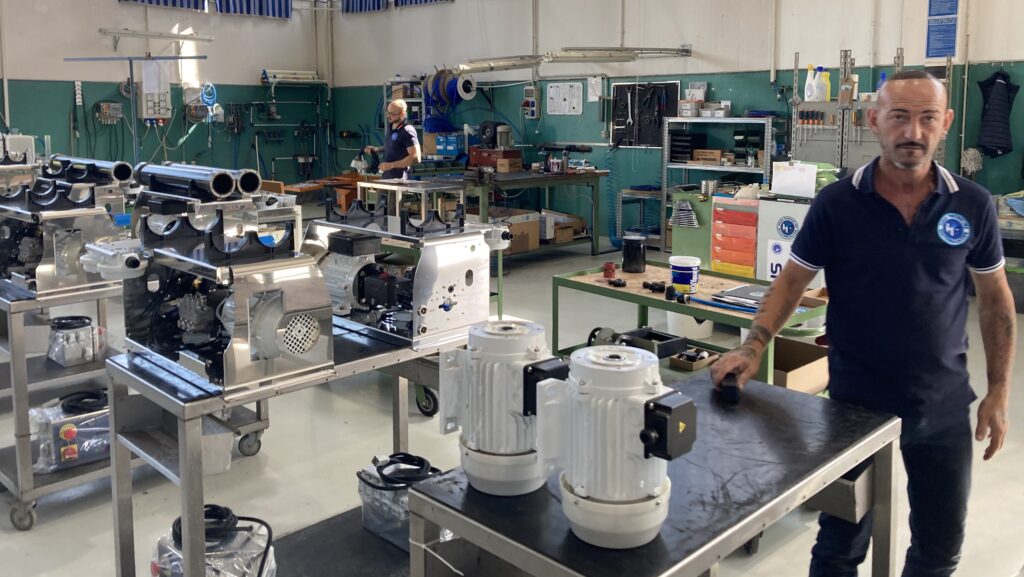
As north Europe and UK representative for Italian marine accessories giant, Osculati, Stevenson (pictured left) is well placed to take the temperature of the market. And he says trade conditions for UK businesses are a growing concern. Dynamism is what the market needs to rebuild and cement growth.
UK trading woes
“The current leisure marine market conditions are challenging, the market is contracting, and trading is tough with inflation and regulatory issues,” he says.
Stevenson has registered a drop in UK demand over the past year, which he puts down to “a lack of confidence and reluctance to spend money. Peace in Europe would be the most effective stimulus for growth and confidence in Europe,” he asserts.
There are seeds of positive growth, though: “If I were to look at the UK tender builders, I feel they are certainly leading the way.
“There have been highlights, in particular, the spectacle of the Cannes boat show was outstanding. However, how much of the glamour has translated into orders is still to be confirmed.
“From an equipment supplier point of view, I believe the 45-80ft sector will contract by about 10-12 per cent. While the smaller boatbuilders (up to about €150K in value/outboard boats to 8m) – having been quite stagnant for the past two years – should start to see demand again, as the covid bounce boats flush through the dealers.”
Sector strength in 2026
Stevenson notes that market segments such as defence are providing additional welcome activity. Sentiments echoed by manufacturers at Metstrade – companies including LXNAV and RAD Propulsion noted that their defence business was posting some of the strongest figures across orders.
“We work in all sectors. I am starting to see commercial pick up. But the area where we are seeing a lot more development in boatbuilding is supplying the defence sector,” adds Stevenson.
Defence is not a new sector for Osculati, but the innovation and technical leaps are very interesting for the supplier, in particular in the autonomous craft arena.
Looking to 2026, Stevenson is reasonably confident the company will be able to maintain the current level of sales. “We will have to work a lot harder to achieve this,” he explains, “and we will have to diversify in order to achieve this.”
Across the marine industry, geopolitical tensions are not conducive to a buoyant sales market. “Undoubtedly the world has become more unstable in recent times and that affects confidence. If we look to Ukraine and what has happened to the largest RIB builder in Europe, it does not take a genius to say we need a stable environment to build confidence and return some optimism. The same could be said for punitive tariffs set by the USA, that just hurt their own domestic consumers in the short term.”
Adopting AI: how is it changing the business?
AI promises one of the biggest step changes for the sector. Osculati introduced AI-driven systems to improve sales forecasting, purchasing decisions and product information management, to improve efficiency.
“When people understand how to use it and what it can offer, it will change the way we work. At Osculati, we are already using it to aid internal and external partners – to help them understand what our products can do as well as many other areas internally.”
AEmilio is Osculati’s homegrown AI system, and is trained on the company’s catalogue and technical information, to answer customer queries 24/7. That’s no small feat, considering there are over 20,000 items in the Osculati catalogue (a significant chunk of those are made in Osculati’s own facilities, which span two sites – Milan and Lucca).
Stevenson says: “By analysing years of historical data, seasonal trends and market signals, Osculati’s AI tools can predict demand more accurately. This helps with many aspects of the business, making us better able to manage stock, ensuring high-demand items are always available, while avoiding unnecessary overstock.
“AI also plays a growing role in managing product information, for our customers and end users. With thousands of SKUs and multiple languages to maintain intelligent systems for classifying, translating and enriching product data. This ensures consistency and accuracy across the Osculati catalogues and online platforms, improving internal efficiency and the customer experience.
“By automating repetitive tasks and providing deeper insights, AI allows our teams to focus on the higher-value activities.
“As the marine industry embraces digital transformation, Osculati’s use of AI demonstrates how technology can deliver real-world benefits in supply chain management, accuracy and responsiveness, helping the company and its customers navigate the future with confidence.”
UK boat shows: can they remain relevant?
Boat shows and marine events provide an important point of connection throughout the calendar for the company, but Stevenson warns that some UK events could struggle if they do not move with the times.
“Every person involved in the UK leisure marine industry has a vested interest in making the main domestic boat show work,” he says. “Sadly, the Southampton show was quite disappointing and needs a major rethink. I feel it will struggle to be commercially viable for the exhibitors next year, let alone the organisers.
“Why it cannot be combined with Seaworks in some way is beyond me. Wasting time and money to create two shows in the same location a few months apart is just not sensible. Why not combine and hold the boat show in June when organisers can take advantage of the nice long warmer days?
“For example, one weekend Seaworks, and then the next weekend is dedicated to a leisure marine show – the costs would halve. Maybe I don’t understand how these things work, but it seems logical to me. Changing the dates would also remove it from clashing with much bigger European shows held in September.”
UK government support for the marine sector
Reflecting on the policy support for UK marine sectors, particularly compared with other manufacturing sectors, Stevenson says the government could do better, and the disconnect with industry bodies is not helping the domestic market.
“I feel the way the support is provided could be better. Government relations are channelled via British Marine (mainly), but many people do not think British Marine is relevant to their business and has no value versus the costs they are charging members. This needs to be addressed – subscriptions have to reflect what member companies can afford, and this is not the case at the moment.”
The post New strategies and support needed for UK marine business, says Osculati appeared first on Marine Industry News.