British engineering firm Helix may be well known in Formula 1 circles but it is now bringing power-dense electric propulsion to the water.
Helix, the British engineering powerhouse best known for its work with Formula 1 and Formula E teams, is quietly rewriting the rules of marine electrification. Drawing on its motorsport pedigree and proprietary scalable core technology, the company is now targeting the marine sector with compact, high-efficiency electric propulsion systems.
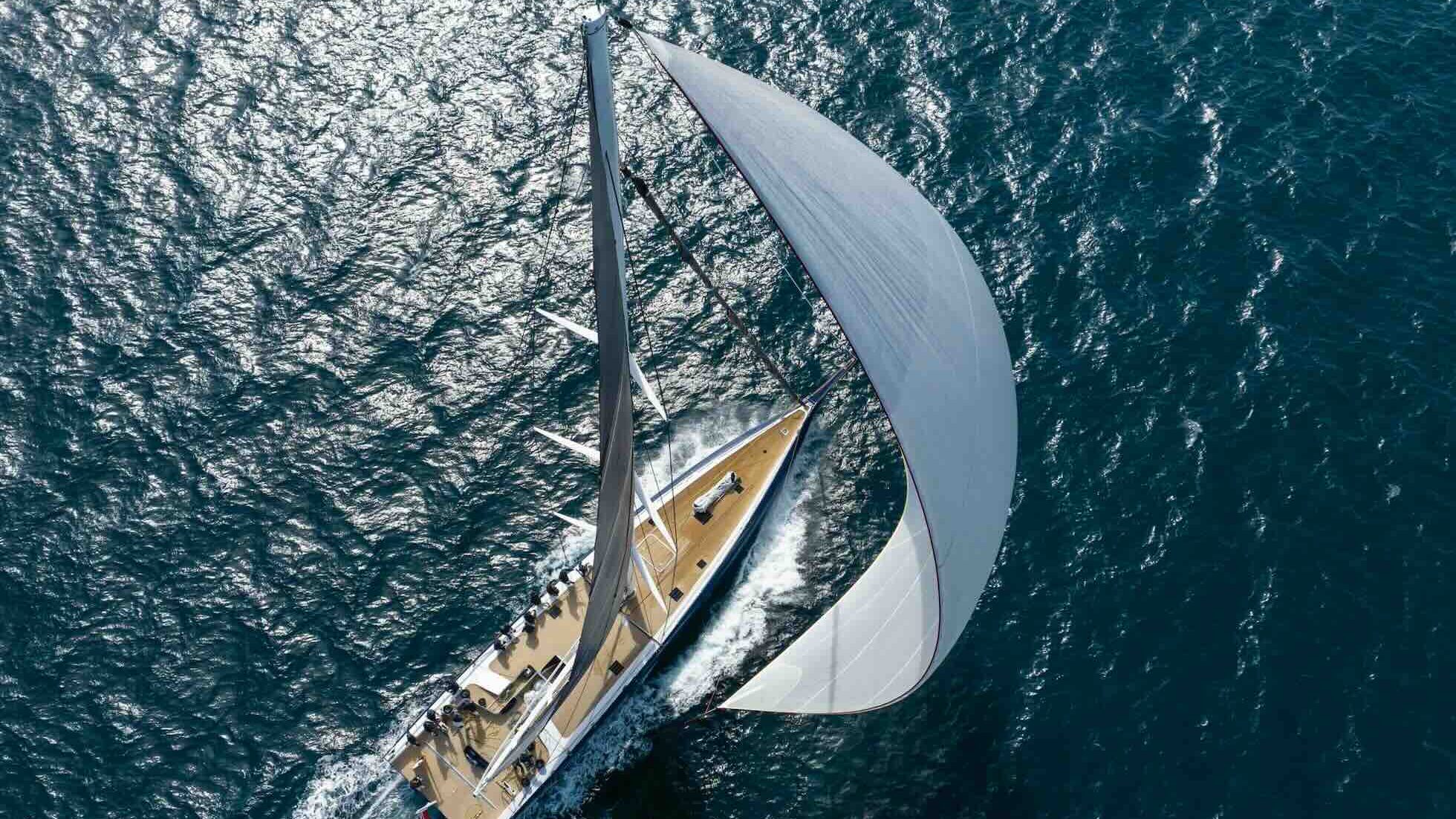
With projects such as the hybrid-powered Magic Carpet e already on the water, Helix is positioning itself at the forefront of a new era in marine propulsion.
Creating Magic Carpet e
Based in Milton Keynes in the UK, Helix (a trading name of Integral Powertrain Ltd) supplies manufacturers of electric and hybrid cars, motorcycles, and boats, as well as next-generation industrial and aerospace applications with electric motors and converters.
While the company has long-established roots in the automotive sector, Helix most recently supplied its electric motor technology in the Magic Carpet e high-performance sailing yacht.
Commissioned by former L’Oréal CEO and chairman Sir Lindsay Owen-Jones, Magic Carpet e is a series-hybrid yacht powered by a 101kWh battery system. Helix partnered with Persico Marine – the yacht’s design and engineering lead – to deliver three ultra-high-performance motors for the project.
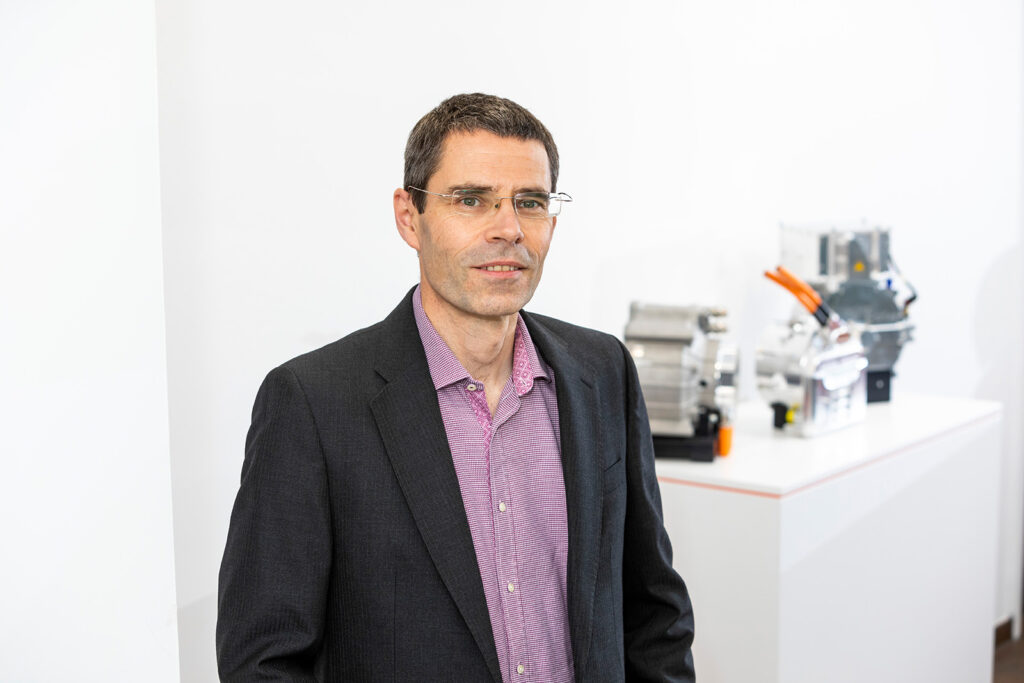
Helix’s marine developments have been spearheaded by marine chief engineer James Edwards (pictured), who joined the company in 2015 to lead its strategic move into marine electrification.
His automotive engineering background has provided critical cross-sector insight as Helix adapts its powertrain expertise for the demands of the marine environment.
“I have 30 years’ experience as a powertrain engineer and my career has focussed on vehicle powertrain development, emissions, and driveability with a wide range of technologies from diesel, gasoline, LPG, CNG, battery-electric, hydraulic drives, series- and parallel hybrids, and hydrogen fuel cells.”
Translating Formula 1 technology to the water
Helix has supplied electric motors to Formula 1 teams for more than a decade. “We also develop hardware for several Formula E teams and have a technical partnership with Kiro Race Co. These applications are the backdrop to wide success in almost all forms of electric and hybrid racing, and this includes one-off vehicles such as the record-breaking Volkswagen ID.R Pikes Peak challenger,” explains Edwards.
Helix’s motorsport group works at the cutting edge, testing new concepts and developing greater power density. This learning is then cascaded into the products that the other Helix groups can offer to their sectors and much of the motorsport expertise has directly informed the company’s marine offering.
“Over the course of our work with Formula 1 and Formula E, we developed a range of one-off solutions which offered the highest power density of any solution in the market.
“In motorsport, what matters is peak power – how much power a motor can put out in a short burst. But we realised that the continuous power of our technology could be of great importance for a range of sectors, including marine.
“These systems [built for Formula 1] and concepts transfer directly over to marine applications, where the weight sensitivity and small package requirement can offer exceptional benefits and flexibility to the vessel designer and owner.
“Dense units that provide high continuous power are key to making electrification work in marine.”
Helix now offers a range of scalable products designed to serve the full spectrum of marine propulsion and auxiliary systems.
“Our motors are available in various sizes and form factors, making them deployable across a boat. Along with propulsion, our motors are ideal for generators, pumps and actuators, providing a much more lightweight solution than traditional hydraulics.
“In addition, we also offer inverters and power electronics systems to control and regulate motors.
And, critically, we offer fully integrated electric drive and propulsion units that bring motors and inverters together for best-in-class solutions.”
Edwards’ other career highlights include serving as lead engineer on the development and integration of a 110kW fuel cell system for a major European OEM; leading the creation and calibration of the UK’s first hybrid bus (the Wright Electrocity); and overseeing an award-winning portfolio of alternative-fuel vehicles for Vauxhall Motors – more than 20 variants that together formed the largest OEM range in Europe.
Aiming for plug and play
The company’s long-term goal is to provide fully integrated, plug-and-play systems that simplify installation for OEMs and builders.
Translating Formula 1-grade engineering to the marine segment hasn’t been without its challenges.
“One of the unique aspects of marine is the ability to operate at high load continuously because of the power-law propeller curve and the lack of obstacles. This doesn’t happen in other mobile applications because vehicles normally have a higher power-to-weight ratio, and are constrained by obstacles, legislation, or – in the case of aircraft – fuel economy. However, because of Helix’s motorsport background, this is an area that we are uniquely prepared to deliver in.
“Corrosion protection was more of a departure, but fortunately with help from our customers and suppliers we have been able to develop a multi-layer coating system that, along with IP6K9K ingress compliance, can withstand the worst that the ocean can throw at it.”
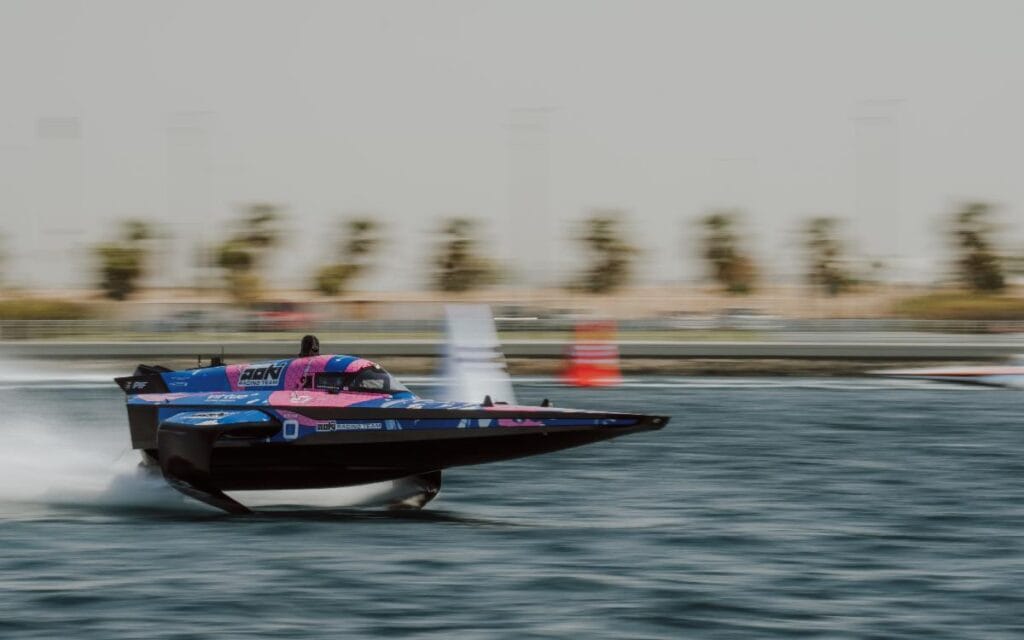
Helix’s strategy for entering the marine market began “close to home”, working with racing and powerboats – such as the E1 Race Series.
“We’ve branched out to offering solutions for racing yachts and sail boats, such as for the Magic Carpet e that launched in May 2025.
“Building on these foundations, some top marine targets for us are markets like service vessels, tugs, and yachts.
“Mid-sized vessels that spend a lot of time at sea idling are ideal electrification targets and perfect for Helix – before us, many simply didn’t have access to motor or e-drive solutions that can compete with traditional combustion.
“We’re also well-positioned to help with the scaling of next-generation vehicle architectures. Vessel designs like hydrofoils go hand-in-hand with electrification – compared to engines and the accompanying drivelines and fuel lines, motors are far easier to install on a foil. Plus, decarbonisation and the marine industry’s journey towards net zero, our power density is key to allowing larger vessels to reduce their emissions footprint and fuel consumption.”
Boatbuilder partnerships
Edwards confirms the company is working – and has confidentiality agreements at play – with many large boatbuilders.
“In my opinion we are very well placed to support the move to foiling vessels by providing ultra small diameter power units to integrate into fast ferries, larger leisure and small commercial applications.”
Rather than playing second fiddle, marine now forms a central pillar of Helix’s strategic growth plan.
“Marine is at the top of our target sectors, and we believe it will represent one of our biggest markets in the coming years,” he adds.
“We can enable miniaturisation and mass savings in the order of multiples for many propulsion and actuator systems. This doesn’t just reduce vehicle mass, but it also dramatically changes the layout of a vessel’s interior – floorspace that previously would be reserved for engines and pumps can be freed up for passengers, crew, or cargo. And by cutting many of the operating costs around maintenance and fuel, we think marine electrification could revolutionise the business model for many operators.”
The post From F1 to electric propulsion: Helix ramps up appeared first on Marine Industry News.