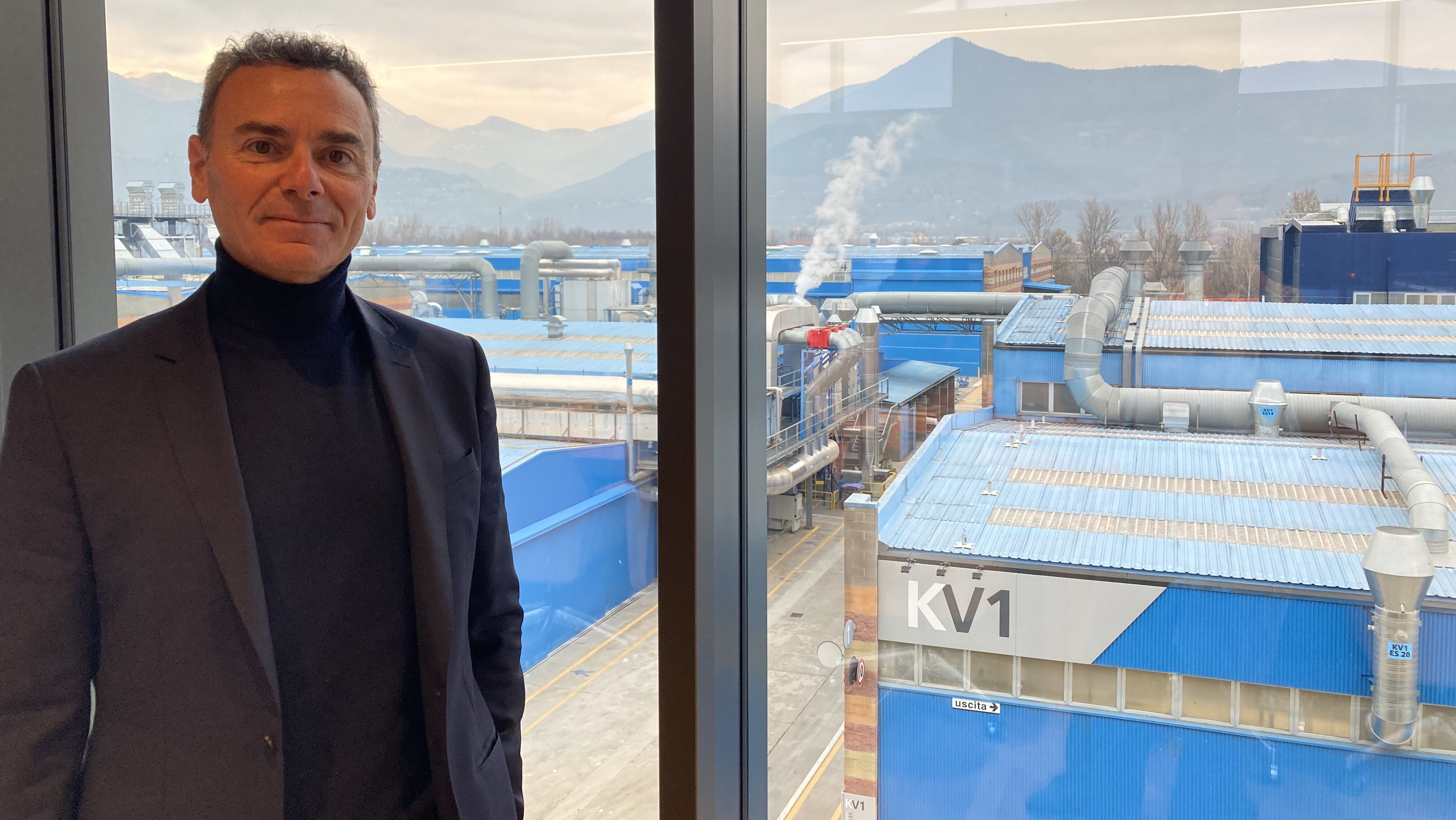
Three decades ago, Marco Valle walked into Azimut Yachts with an MBA and a promise to himself that he’d stay no longer than a year. Instead, he found a company – and an industry – in which to grow up. Today, as the first CEO overseeing the combined Azimut-Benetti group, he’s steering a €1.5bn giant through one of the most complex transitions the superyacht world has faced.
Marco Valle has worked for one company in his life. From his start in 1996, where he began in sales, Valle has risen to be the first CEO of the grouping of Azimut-Benetti.
“I said I will stay no longer than one year,” he says. But like many in the marine world, once he was in, he stayed. “I grew up in this company, as [at the same time] the company was growing in an incredible way.”
The last few years have followed that growth trend. The company’s has again topped the Global Order Book ranking.
Uniting Azimut and Benetti: €700m becomes €1.5bn
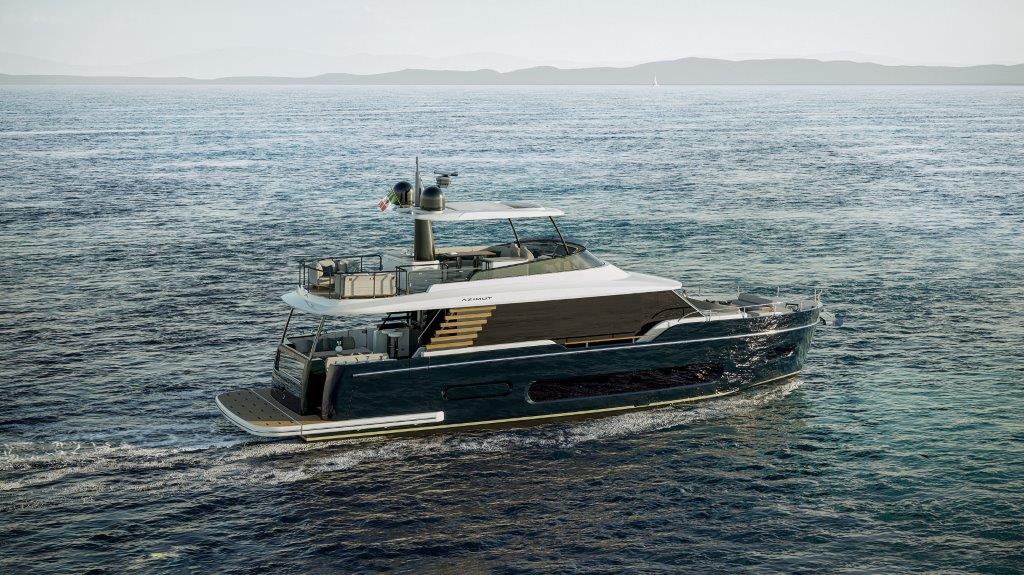
The Azimut and Benetti brands conjoined in 2020. Azimut Yachts focuses on stylish, innovative motor yachts from 34 to 120 feet while Benetti specialises in custom steel and aluminium superyachts (30m+) and megayachts. The company operates in Europe, Americas, Middle East and Asia, with numerous sales and service points.
When the brands joined “we had turnover close to €700 million. We closed the last fiscal year (August 2025), close to €1.5 billion. It’s quite a leap. We had a great increase, like everybody in this industry over the last period.”
Market slowdown: where the real shifts are happening
But, the market is changing and for manufactures in the larger yacht segment like Azimut-Benetti, the slow-down is real.
“We will see in 2026, that it will not be so easy,” Valle says.
Seven months ago, he told his followers on LinkedIn that the market for larger yachts was immune. And now?
“At the moment, the demand is still good [in the large yacht market] for two reasons. First because there are clients. Secondly, because there is a limited number of boats available in the market.
“It’s a combination of the two.”
But what is changing is the way that the market’s splitting. Last year it had “two different speeds” for boats below, and above, 70 feet. The latter was faster, the former slower.
“This border has been raised. The bar is now 80 feet. From what I’m seeing now, in the next six-seven months, the bar will be raised up to 30 metres. Slowing down has also increased for bigger boats. The limit was 24 metres – in the next six months it will be raised up to 30 metres – above 30 metres is still very active.”
Regional trends for yacht sales
The USA, strong for the company over the last 14 years, has – unsurprisingly – suffered as a market. “Everybody can confirm this. It’s not only Azimut.”
But, Valle says this is being compensated by sales in Europe and the Middle East. The “Middle East is the one [area] with the highest growth rate.”
In September 2025, the company announced sales exceeding €300m in Saudi Arabia (over the past two years) and new offices opening in Gedda and Riyadh. (In 2023, a Saudi fund acquired 33 per cent of Azimut-Benetti Group.)
Saudi ambitions and the Red Sea opportunities
Valle’s “trying to open the market more and more”. He acknowledges that there’s “a different perception from here in Europe” , regarding Saudi’s records on human rights.
“For sure they are interesting,” he says.
It’s well known Red Sea development keeps on coming. A yachting paradise is being constructed to woo owners.
“It’s a process. We are present in the Gulf – Dubai and Kuwait, Qatar, Bahrain, Oman. [These] areas have been very important for us. I remember when Dubai started, I was there. It was not the Dubai of today. Saudi will follow the same path… There are a lot of potential buyers, especially for big yachts.”
The second-hand surge and the margin squeeze
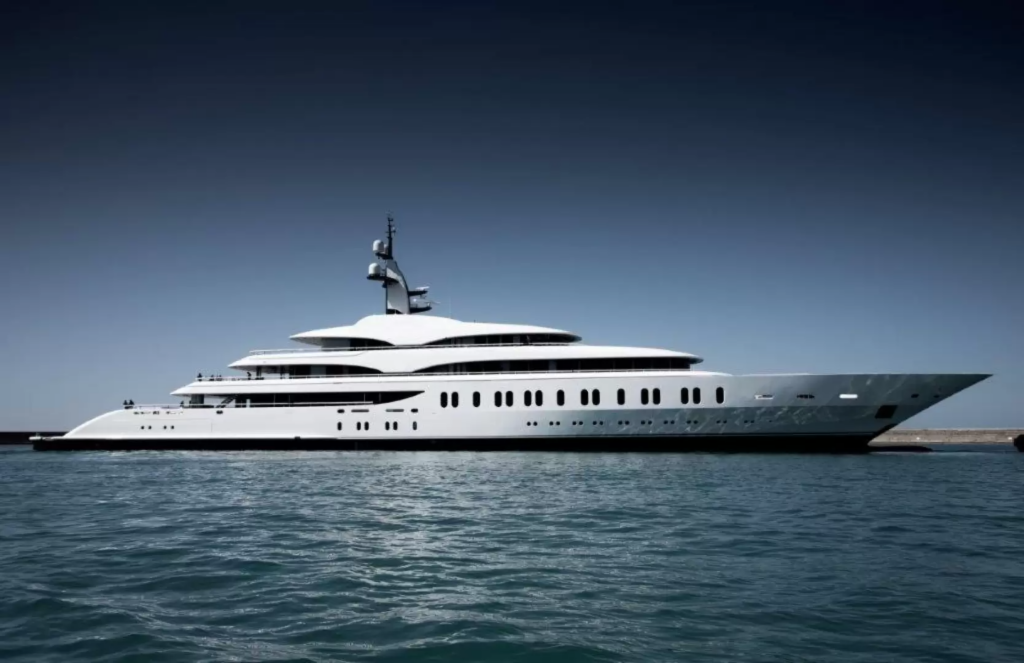
A challenge for 2026 is the growth of the second-hand market. The number of boats available has increased and Valle notes that “they are competing with the new-new production”. Thus comes having to justify why clients have to pay much more for a new boat when there’re six or seven year old models on offer.
“The number of clients will be reduced,” he predicts for 2026, “and at the same time, margins will be affected. The margin will be affected after many, many years of a golden age.”
“Either you are able to work on the cost of the production process, or yards will have difficulty to survive.”
Innovation pressure: why yards must reinvent
Boatbuilders need to be much more effective in maintaining control of the cost in production – from the starting concept of the boat to finding new suppliers. And with increased squeeze, Valle believes that the resulting competition will be good for the market.
“It’s been too easy with more clients than boats. The demand was higher than supply. The only task was to produce more because you have your demand, the design, and what you can provide.”
This means that companies were not investing to find new technologies, or new solutions for both the production process and/or the components of the process.
For the whole of the wider market, he says, competition was not considered a risk in the past few years. “Not a lot of effort was put into finding new solutions. You do not evolve. Nowadays that the market is more difficult, I believe companies will reinvent themselves to find new technology.”
Along the same lines, Valle warns that the whole supply chain has to change. Suppliers need to rethink their pricing.
“It’s always difficult to go back to previous prices once you set the prices at the highest level.”

The service revolution owners now expect
Another challenge which all boatbuilders face is how their vessels will be serviced. A new generation of people are coming onboard who don’t want to solve problems by themselves, and don’t want to get out a screwdriver. They want to use apps.
“This is what this industry has to follow-up. The challenge for the future will be to have a boat that it will be easy to use, easy to maintain, free of any problem.”
But any owner knows that problems occur. The difference, Valle says, is in how problems will be detected and solved. “Electronics will make the difference, because sometimes most of the boats are components assembled by the yard, but produced by somebody else.”
Currently “they are not interfacing. And this will be the real future for this kind of product, that everything has to be integrated in a way that to some point you can predict problems that you can solve in advance.”
“It’s a step where the boat will become more and more complex to make your life easier.”
And as they become more complex, they need to have the proper service behind. “Otherwise, it will be a boomerang.” Boats will leave the yard only to return for maintenance.
Challenges of international markets
That’s also the challenge of success in international markets. There are Azimut-Benetti owners around the world.
“If you provide components onboard, and that boat stays outside of your main location, you have to provide the proper service. In the past we had some small suppliers that failed because they were not able to provide the proper service locally.
“We are selling more than 250 units per year (nothing compared with the other industries)” but the product moves to worldwide locations – with owners needing the same components in diverse places such as Singapore and Acapulco.
“You have to guarantee the fact that if something fails, you are following up. This is the reason why we have service centres in many areas of the world. We are developing agreements with service centres worldwide, but at the same time we ask our suppliers to be present, with our support, to provide the right service activities.”
Azimut-Benetti recently announced a significant strategic move in the launch of the Azimut-Benetti Group service division, signalling a shift towards lifecycle support and experience-led ownership.
Bringing production in-house to control cost and quality
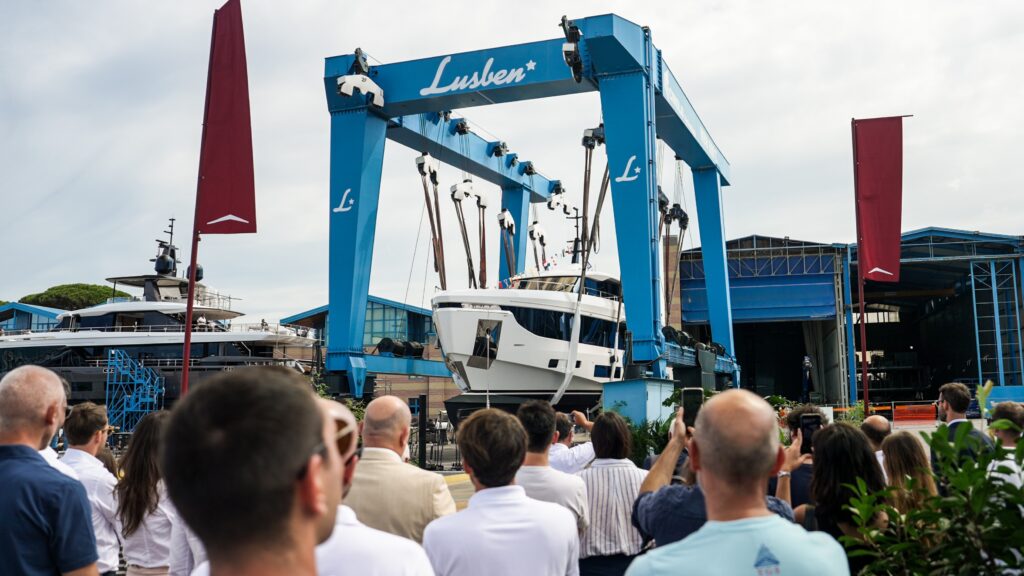
A few years ago, the company made a strategic decision to bring the production of all its fibreglass and steel in-house, aiming to improve quality, gain greater control over production and manage costs more effectively. The move was driven in part by pressure across the supply chain, as demand increased without a corresponding rise in the number of suppliers, pushing material prices higher.
As Valle explains: “Everybody was asking the supply chain to produce more parts. When demand is high, and the number of suppliers are still the same, the cost of the price of all these materials increased.” By internalising production, the company also reduced its reliance on suppliers that were simultaneously serving competitors, helping it protect build quality, delivery timelines and pricing. According to Valle, those objectives are now being realised, with the benefits becoming clearly visible this year.

Sustainability: HVO and hybrid propulsion
This internal production process means that Valle ranks the company – with current products and its technology – as between 8 and 9 on MIN‘s hastily convened scale for sustainability, with 10 being fully compliant. He cites examples as infrastructure in carbon fibre and lighter weight structures as well as decreases in consumption and each boat’s emission level targets constantly being a specified percentage lower than the previous model.
“The carbon consumption level, on average, is lower than any other direct competitors in the same segments,” he says.
Azimut-Benetti’s also fully behind HVO (hydrotreated vegetable oil).
“That is the only solution in the short term that can have a real reduction of emission.” How the HVO is produced means there is, he says, an 80 per cent reduction of CO2.
“We are buying HVO. All our yards are fuelled with HVO, all our boats. Our clients, if they want, can buy HVO from us.”
Hybrid propulsion is way up his agenda. This makes the company’s output more comfortable as hybrid propulsion can keep the boats running with batteries – instead of generators – thus reducing noise, vibration and direct pollution.
“It provides a higher level of comfort on boats. Most of the boats stay at anchor 80 per cent of the time. You have to invest in all systems, like hybrid propulsion, to keep the boats running with batteries. We are pushing that direction in order to provide the higher level of comfort on boats.
“We try to avoid just one single marketing product to launch as a flag. It doesn’t make any sense. We are very pragmatic. So we try to say ‘if it’s really useful for the client, let’s make it, because it makes sense’.
“But, to be honest, worldwide owners are not following a sustainable effect in order to select their boats.”
Personal evolution: how challenge keeps Valle motivated
Arguably, being in the same company for so long could lead to complacency. But Valle says this hasn’t happened to him. Every time he’s in a new role (he’s been sales director, Azimut general manager, CEO then CEO of the group), it’s come with challenge.
The market’s activities have provided the disruption and engaged him in periods of new thinking. He cites “the world collapse” in 2008 as a moment that required reinventing himself to think in different ways, and then again when covid arrived. “The market boomed and my role changed.”
And again in 2020, when he moved to Benetti, “it was a totally new product to learn, a totally new process to follow and there was quite a difficult period, to be honest. One of the most difficult periods that I faced in 2020-21, a difficult period.”

Balancing two identities: the ongoing Azimut-Benetti integration
Valle was made group CEO in September 2020. With the company unsure of what the future held, and in the grasps of covid, the owning family decided to combine the two divisions, looking for integration in areas such as human resources, IT and finances.
After 25 years in Azimut, he had to learn about Benetti – the brand, the products, the mega yachts, steel production and more. “It was a quite interesting period, because it was, for me, a challenge.”
“The most difficult thing is to try to keep the two identities divided and separated in some way. It’s important to have two DNAs but, at the same time, try to get the best of each division and the best practice. It’s a process that is difficult to keep ongoing and it’s not finished yet.”
“We are still investing in the product,” he says. “We never stop investing in our new new yachts and research development. This is something that is the real secret of this company. And everything is related to this.”
As 2026 approaches, Valle isn’t underestimating the challenges ahead – from slowing demand to rising competition, via service expectations to sustainability. His message is consistent: evolution is unavoidable. The best shipyards will be the ones that embrace it and rethink how the industry moves forward.
The post Interview: Marco Valle on market shifts, 2026 challenges, and three decades with Azimut-Benetti appeared first on Marine Industry News.