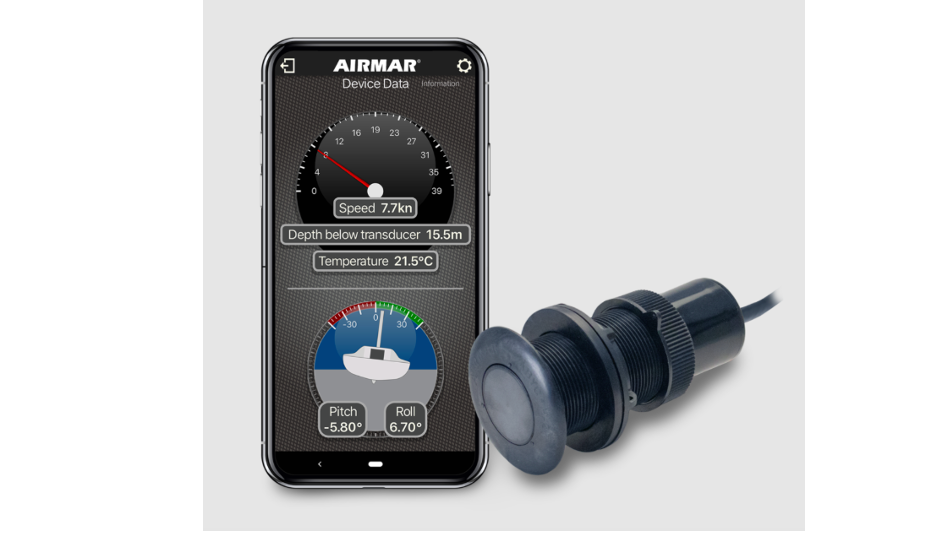
Airmar is targeting one of the more routine maintenance jobs on boats with a new multisensor that measures speed through water using ultrasonic technology rather than a paddlewheel. The TriSonic Smart Multisensor has no moving parts, and its speed data can be calibrated from a smartphone using Airmar’s CAST app.
“We’ve eliminated moving parts and the burden of paddlewheel maintenance caused by marine growth,” says Craig Cushman, director of marketing.
Ultrasonic speed measurement
The TriSonic is designed for recreational vessels and connects to NMEA 2000 networks. Alongside speed through water, it provides depth, water temperature, and heel and trim data.
The processing electronics are inside the sensor body, removing the need for an external junction box. For existing boats, the unit can be retrofitted into standard Airmar two-inch thru-hull housings used by traditional paddlewheel and earlier ultrasonic sensors.
Paddlewheel speed sensors remain widely used, but they have a straightforward maintenance problem: the moving wheel sits in the water and can be affected by marine growth. That can lead to inaccurate readings or stop the wheel turning altogether, requiring the sensor to be cleaned.
Calibration from a phone
The ultrasonic sensor development is only part of the story. Airmar is also making calibration a significant part of the TriSonic proposition.
The company’s existing DST810 brought advanced speed calibration to its CAST smartphone app – it’s now being replaced by by DST820 (Smart Multisensor with Gen2 Paddlewheel).
The TriSonic carries that approach into an ultrasonic sensor. Users can make speed calibration and offset adjustments from a smartphone, while the CAST app displays live data numerically and graphically rather than relying on specialist equipment or software.
Bluetooth connectivity seemingly extends up to 30ft across the boat.
Networked marine electronics
TriSonic also reflects a wider change in marine electronics: individual sensors are increasingly expected to provide data to a connected boat system rather than simply feed one instrument.
The unit combines speed through water, depth, water temperature, heel and trim data, with NMEA 2000 connectivity and Bluetooth for connection to the CAST app. Once data is available on an NMEA 2000 network, it can be shared with other compatible equipment on the boat, depending on the installation making the sensor a data source within the boat’s wider architecture.
Dual sensors for multihulls
Airmar is also offering a TriSonic 2 system for catamarans and other multihulls.
The system uses two TriSonic sensors that communicate with each other to determine which sensor is sitting lowest in the water and switches between them automatically, with the lower sensor typically sitting in less aerated water and therefore providing the preferred source for speed and depth readings.
Airmar’s changing approach to speed sensing
Airmar has been developing both sides of the technology – with and without the paddlewheel. The TriSonic therefore does not appear to mark Airmar abandoning paddlewheels. Instead, it shows the company continuing to pursue two approaches to speed sensing: improving the performance of a mechanical paddlewheel while developing ultrasonic sensing as an alternative with both utilising features Airmar has been developing around its paddlewheel sensors.
Airmar is now offering boatbuilders and owners a choice between a highly developed mechanical speed sensor and a smart ultrasonic alternative, while keeping both within the same broader connected-electronics ecosystem.
The post Airmar takes the paddlewheel out of speed sensing appeared first on Marine Industry News.